

L'huile de carthame est obtenue par pression des graines de Carthamus tinctorius — une plante annuelle de la famille des Astéracées, également connue sous le nom de « faux safran » ou « safran des teinturiers ». Ce produit est parfois commercialisé sous le nom d’« huile de safran, », bien qu’il n’ait aucun lien avec la précieuse épice culinaire du même nom; cette confusion terminologique provient de l’utilisation des fleurs de carthame comme colorant — leurs fleurs aux couleurs intenses vont du jaune au rouge vif. Au-delà de la pigmentation, la plante fournit un certain nombre de produits utiles, dont le plus précieux sur le plan nutritionnel est sans aucun doute son huile pressée à froid. Pourquoi l'huile de carthame mérite-t-elle qu'on s'y intéresse?
Composition: ce que contient l'huile de carthame
Le profil de l'huile de carthame présente certaines similitudes avec celui de l'huile de tournesol, mais avec quelques distinctions importantes. Ses constituants dominants sont des acides gras à longue chaîne — principalement l'acide linoléique, l'acide oméga-6 (, l'acide alpha-linolénique, l'acide oléique, l'acide palmitique, l'acide arachidique, et l'acide stéarique. La présence d'acides gras à longue chaîne est particulièrement importante car ce sont les formes moléculaires sous lesquelles la vitamine D est le mieux absorbée — ce qui fait de l'huile de carthame un complément alimentaire utile pour la supplémentation en vitamine D. Outre son profil en acides gras, l'huile de carthame contient des phytostérols et deux vitamines aux propriétés antioxydantes : les vitamines A et E.
Propriétés et bienfaits pour la santé
Soutien cardiovasculaire et métabolique
L'huile de carthame est une excellente source d'acides gras saturés UNS, dont l'acide linoléique (, le CLA) comme composant principal. Le CLA a démontré une capacité spécifique à agir sur le tissu adipeux — en réduisant la graisse corporelle et en facilitant la gestion du poids —, ce qui rend l'huile de carthame particulièrement intéressante pour les personnes qui surveillent leur poids. Elle joue également un rôle significatif dans la régulation du cholestérol, contribuant à un profil lipidique sanguin plus sain, à une réduction du risque d'athérosclérose, et à une amélioration de la fonction cardiovasculaire. Les composés présents dans l'huile renforcent les parois des vaisseaux sanguins, améliorent la circulation, et réduisent le risque de thrombose. En favorisant le maintien d'une glycémie normale, l'huile de carthame réduit en outre le risque de diabète et aide à gérer la faim — un avantage secondaire pour le contrôle du poids.
L'acide linoléique, en particulier, a été associé à une protection contre la perte de masse osseuse et la diminution de la densité minérale osseuse, ce qui fait de l'huile de carthame un élément à prendre en compte pour les personnes âgées à risque d'ostéoporose. Cette huile présente également des propriétés anti-inflammatoires, analgésiques, antispasmodiques, diaphorétiques, purifiantes, diurétiques et calmantes — un large éventail de fonctions pour une seule huile alimentaire.
Bienfaits spécifiques pour les femmes
L'huile de carthame peut présenter un intérêt particulier pour les femmes. Elle permettrait de réduire les douleurs menstruelles et, pendant la transition vers la ménopause, ainsi que de favoriser l'amélioration du métabolisme et de la fonction digestive. Sa teneur en phytostérols et en acides gras contribue à l'équilibre hormonal pendant cette période.
Cependant,, une contre-indication importante s'applique: l'huile de carthame n'est pas recommandée pendant la grossesse, lors d'une tentative de conception, ou pendant l'allaitement, en raison de ses propriétés relaxantes relativement fortes sur les muscles utérins. Il s'agit d'une contre-indication formelle, et non d'une simple précaution.
L'huile de carthame dans les cosmétiques et l'usage externe
L'huile de carthame est largement utilisée dans les applications cosmétiques et de soins personnels. Utilisée dans les routines d'épilation et de dépilation, elle adoucit les poils, réduit l'inflammation post-épilation (, les boutons rouges et les taches qui apparaissent couramment), ralentit la repousse, et rend les poils progressivement plus fins au fil du temps. Elle apaise les sensations d'inconfort pendant et après l'intervention et laisse la peau lisse plus longtemps.
Pour le visage, l'huile de carthame est particulièrement adaptée aux peaux à tendance acnéique, grasses, et mixtes. Elle hydrate en profondeur et régénère; elle possède des propriétés antioxydantes qui améliorent l'élasticité de la peau et atténuent les ridules; grâce à sa teneur en vitamine E et en acide linoléique, elle aide à atténuer les effets néfastes de l'exposition aux UV. Appliquée le soir sur un visage nettoyé, elle pénètre bien sans laisser de résidus gras. Pour les cheveux, elle adoucit, renforce et accélère la pousse en nourrissant et en stimulant les follicules — appliquée sur la longueur des cheveux avant le lavage et laissée agir 20 à 30 minutes avant le rinçage.
L'huile de carthame sert également d'huile de support efficace pour diluer les huiles essentielles dans les formules de massage corporel, et d'additif enrichissant pour les produits cosmétiques existants.
Mode d'emploi de l'huile de carthame
L'huile de carthame a une couleur claire et un goût légèrement amer, discret. Pour un usage interne, la quantité standard recommandée est de 15 ml par jour. Comme toutes les huiles végétales pressées à froid, elle doit être consommée froide — elle ne doit jamais être chauffée au-delà d'environ 65 °C, température à laquelle ses composés bénéfiques commencent à se dégrader. Elle convient donc particulièrement bien comme assaisonnement pour les salades, les sauces, les trempettes, les soupes et les desserts, ainsi que comme ingrédient dans les smoothies aux fruits et légumes, où ses acides gras facilitent l'absorption des vitamines liposolubles présentes dans les autres ingrédients. Elle convient également bien à la préparation de mayonnaise maison.
En usage externe, appliquez directement sur la peau ou les cheveux nettoyés selon les besoins, en ajustant la quantité en fonction du type de peau et de la réaction de chacun. Un test cutané est recommandé pour les nouveaux utilisateurs ayant une peau sensible ou réactive.
L'huile de carthame pressée à froid est disponible en plusieurs formats chez Bilovit et Wellbear, dans notre collection Huiles de cuisson et vinaigres.


 5% de réduction
Bilovit
Bilovit Safflower Oil Cold Pressed - 250 ml
Prix soldé €3.89 Prix habituel €4.09Prix unitaire€15.56 /L


Bilovit
Bilovit Huile de Carthame Pressée à Froid - 500 ml
Prix habituel €6.89Prix unitaire€13.78 /L


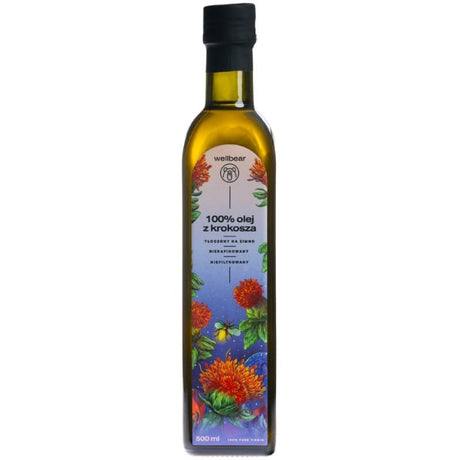


Wellbear
Wellbear Huile de Carthame Pressée a Froid - 500 ml
Prix habituel €11.29Prix unitaire€22.58 /L
Olvita
Olvita Huile de Chardon Marie non purifiée, pressée à froid - 500 ml
Prix habituel €12.59Prix unitaire€25.18 /L


L'huile de carthame se marie bien avec d'autres huiles végétales pressées à froid qui partagent ses UNS acides gras saturés et ses propriétés antioxydantes. Les huiles suivantes complètent ses bienfaits cardiovasculaires, cutanés, et métaboliques. Découvrez la sélection complète dans nos collections Alimentation saine & Nutrition et Soins de la peau & du corps.


Bilovit
Bilovit Golden Flaxseed Oil Cold Pressed - 500 ml
Prix habituel €5.89Prix unitaire€11.78 /L

Olvita
Olvita Huile de chanvre non purifiée pressée à froid - 500 ml
Prix habituel €18.89Prix unitaire€37.78 /L


Bilovit
Bilovit Huile de Chardon Pressée à Froid - 500 ml
Prix habituel €10.19Prix unitaire€40.76 /L


Bilovit
Bilovit Huile de tournesol pressée à froid - 1000 ml
Prix habituel €10.79Prix unitaire€10.79 /L


Cet article est fourni à titre informatif et ne remplace pas un avis médical. En cas de problème de santé, de grossesse, d’allaitement ou de prise de médicaments, consultez un médecin ou un pharmacien. Les compléments alimentaires ne remplacent pas une alimentation variée.


