

Presque tout le monde a déjà entendu parler de l'acide folique, en particulier les femmes qui essaient de concevoir un enfant ou qui en sont au premier ou au deuxième trimestre de leur grossesse. L'acide folique est largement recommandé pour aider à prévenir les anomalies du développement chez le fœtus. Les folates sont toutefois moins connus, même si le folate et l'acide folique sont deux formes du même nutriment : la vitamine B9. Plus précisément, ils représentent deux formes différentes de cette vitamine essentielle. Mais existe-t-il des différences significatives entre elles? Et l'une est-elle meilleure que l'autre?
Que sont les folates?
Le folate est la forme naturelle de la vitamine B9 — un nutriment essentiel que l'organisme ne peut pas produire lui-même. Dans la nature, la vitamine B9 se trouve précisément sous cette forme. Le terme « folate » est en réalité un nom générique désignant un groupe de composés apparentés ayant des propriétés nutritionnelles similaires. La forme biologiquement active de la vitamine B9 est connue sous le nom d'acide lévoméfolique ou de 5-méthyltétrahydrofolate (5-MTHF). C'est sous cette forme qu'il pénètre directement dans la circulation sanguine, d'où il est distribué dans tout l'organisme pour remplir toute une série de fonctions vitales. Parmi ses rôles les plus importants, le folate contribue à la division cellulaire normale, favorise la formation des globules rouges et joue un rôle crucial dans le développement fœtal pendant la grossesse. Il est également associé au soutien cardiovasculaire et peut contribuer à un métabolisme sain de l'homocystéine — un facteur lié à la santé cardiaque. Le folate fait partie de la famille plus large des vitamines B, qui agissent toutes ensemble pour soutenir le métabolisme énergétique et le fonctionnement du système nerveux.
Qu'est-ce que l'acide folique?
L'acide folique — la forme la plus couramment recommandée par les médecins et les gynécologues — est la forme synthétique de la vitamine B9, également connue sous le nom chimique d'acide ptéroylmonoglutamique. C'est la forme la plus fréquemment utilisée dans les compléments alimentaires et elle est souvent ajoutée aux produits alimentaires enrichis pour améliorer leur valeur nutritionnelle.
Pendant de nombreuses années, l'acide folique a été considéré comme supérieur au folate naturel, en grande partie parce qu'on pensait qu'il avait une meilleure biodisponibilité. Cependant, des recherches plus récentes ont révélé une distinction importante dans la manière dont ces deux formes sont métabolisées par l'organisme. Contrairement au folate naturel, qui est converti en sa forme active, le 5-MTHF, directement dans le tube digestif, l'acide folique doit d'abord être acheminé vers le foie pour y être converti. Cela rend le processus considérablement plus lent et moins efficace.
Ce qui rend cette distinction cliniquement pertinente, c'est que la capacité du foie à convertir l'acide folique est limitée. Même des doses modérées peuvent ne pas être entièrement métabolisées, ce qui entraîne une accumulation d'acide folique non métabolisé dans la circulation sanguine. Cela a suscité des inquiétudes parmi les chercheurs, car des taux élevés d'acide folique non converti ont été associés à un risque de masquage d'une carence en vitamine B12 — une affection qui, si elle n'est pas détectée, peut entraîner des complications neurologiques.
Folate ou acide folique — quelle forme est la meilleure?
À la lumière des connaissances scientifiques actuelles, la supériorité autrefois supposée de l'acide folique par rapport au folate naturel semble avoir été fondée sur des connaissances incomplètes. Si l'acide folique est sans aucun doute une forme plus abordable de vitamine B9, sa popularité n'est peut-être pas entièrement justifiée alors que de meilleures alternatives sont disponibles.
Le folate naturel — et en particulier son équivalent sous forme de complément, le méthylfolate (le 5-MTHF) — offre plusieurs avantages :
- Une absorption plus rapide — le folate est converti en sa forme active directement dans le système digestif, sans passer par le foie
- Une biodisponibilité plus élevée — l'organisme peut l'utiliser plus efficacement
- Aucun risque d'accumulation — contrairement à l'acide folique, le folate naturel ne s'accumule pas sous forme de composés non métabolisés dans le sang
- Plus sûr pour les personnes présentant des variants du gène MTHFR — les personnes présentant des polymorphismes courants du gène MTHFR peuvent avoir des difficultés à convertir l'acide folique, ce qui fait du méthylfolate le choix privilégié
Cela signifie-t-il qu'il faut éviter complètement l'acide folique? Pas nécessairement. En cas de carence confirmée, les compléments alimentaires à base d’acide folique peuvent tout de même aider à rétablir des taux adéquats de vitamine B9, car ils contiennent des quantités suffisantes pour compenser la lenteur du processus de conversion. Cependant, lorsqu'on a le choix, les compléments à base de méthylfolate constituent un moyen plus direct et plus efficace de soutenir le statut en vitamine B9.


Now Foods
Now Foods Folate de méthyle 1000 mcg - 90 comprimés
Prix habituel €15.49Prix unitaire€0.17 pièce


Solgar
Solgar Folate 666 mcg DFE ( Metafolin ® 400 mcg ) - 100 Comprimés
Prix habituel €14.99Prix unitaire€0.15 pièce


Jarrow Formulas
Jarrow Formulas Methyl Folate 1000 mcg - 100 Veg Capsules
Prix habituel €27.49Prix unitaire€0.27 pièce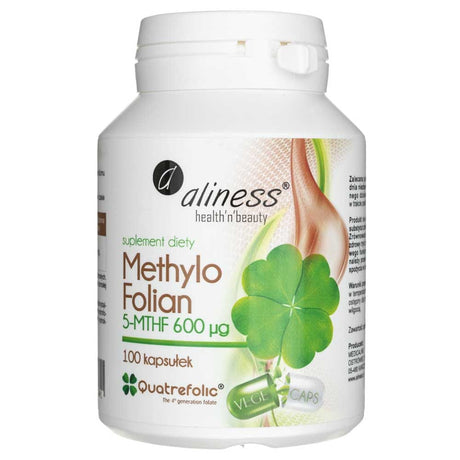


Aliness
Aliness Methylo Folian 5-MTHF 600 mcg - 100 Capsules
Prix habituel €11.09Prix unitaire€0.11 pièce
Kenay
Kenay FOLATE 5-MTHF ( acide folique actif ) Quatrefolic ® - 60 Capsules
Prix habituel €9.19Prix unitaire€0.15 pièce

Life Extension
Life Extension BioActive Folate & Vitamine B12 - 90 Veg Capsules
Prix habituel €10.09Prix unitaire€0.11 pièce


Sources alimentaires naturelles de folate
Le mot « folate » lui-même donne un indice sur l'origine de ce nutriment : il dérive du latin folium, qui signifie « feuille ». Fidèle à son nom, le folate est particulièrement abondant dans les légumes à feuilles vertes. Les sources alimentaires les plus riches comprennent :
- Épinards — l’une des sources naturelles les plus concentrées en folate
- les choux de Bruxelles et la laitue
- les asperges et le chou-fleur
- L'avocat — une source polyvalente et riche en nutriments
- Les légumineuses — lentilles, pois chiches, et haricots
. Intégrer ces aliments à votre alimentation quotidienne est le moyen le plus naturel et le plus efficace de maintenir un taux de vitamine B9 sain. Ces légumes sont largement disponibles sur les marchés européens et apportent non seulement du folate, mais aussi un large éventail d'autres nutriments essentiels.
Le folate pendant la grossesse — Pourquoi est-ce important?
La vitamine B9 — qu'il s'agisse de folate ou d'acide folique — est sans doute surtout connue pour son rôle crucial pendant la grossesse. Un apport adéquat avant la conception et au cours du premier trimestre est essentiel au développement normal du tube neural, qui forme le cerveau et la moelle épinière du bébé. C'est pourquoi les professionnels de santé à travers l'Europe recommandent une supplémentation bien avant et tout au long du début de la grossesse.
Compte tenu de ce que nous savons aujourd'hui sur les différences de métabolisme, de nombreuses formules de compléments prénataux ont commencé à inclure du méthylfolate à la place — ou en plus — de l'acide folique traditionnel. Pour les femmes qui envisagent une grossesse ou qui sont actuellement enceintes, choisir un complément prénatal contenant la forme active du folate peut offrir un soutien plus fiable. Découvrez notre collection santé grossesse pour des compléments prénataux soigneusement sélectionnés parmi des marques de confiance.


Doctor's Best
Doctor's Best Fully Active Folate 400 with Quatrefolic - 90 Veg Capsules
Prix habituel €13.89Prix unitaire€0.15 pièce


Solgar
Solgar Folate 1333 mcg DFE ( Metafolin ® 800 mcg ) - 100 Comprimés
Prix habituel €18.79Prix unitaire€0.19 pièce


Osavi
Osavi MethylFolate et Methyl-B12 - 60 gélules végétales
Prix habituel €8.49Prix unitaire€0.14 pièce


Comment choisir le bon complément de vitamine B9
Lorsque vous achetez un complément de vitamine B9, recherchez des produits qui précisent la forme de folate qu'ils contiennent. Les étiquettes qui mentionnent 5-MTHF, méthylfolate, Metafolin ®, ou Quatrefolic ® indiquent la forme active et biodisponible de la vitamine B9. Ces formes brevetées comptent parmi les plus reconnues dans l'industrie des compléments alimentaires et sont utilisées par des marques de premier plan, notamment Solgar,, Jarrow Formulas,, Now Foods,, et Doctor's Best.
Si vous hésitez entre un complément standard à base d'acide folique et un produit à base de méthylfolate, tenez compte de vos besoins individuels. Pour le maintien d'une bonne santé générale et en particulier pour le soutien cardiovasculaire, la forme active du folate peut offrir une voie d'action plus efficace. Chez Medpak, nous proposons les deux options — toutes Hipp expédiées depuis l'UE pour une livraison rapide, et pratique en Europe.
Point clé: L'acide folique et le folate sont tous deux des formes de vitamine B9, mais ils diffèrent considérablement dans la manière dont l'organisme les métabolise. Le folate naturel et son équivalent sous forme de complément, le méthylfolate (5-MTHF), sont absorbés plus efficacement, ne nécessitent pas de conversion hépatique et ne présentent aucun risque d'accumulation, ce qui en fait le choix privilégié pour la plupart des personnes. Que ce soit par le biais d'une alimentation riche en légumes verts à feuilles ou par une supplémentation ciblée, il est essentiel de garantir un apport adéquat en vitamine B9 pour la santé générale, la fonction cardiaque, et surtout le développement fœtal pendant la grossesse.
Cet article est fourni à titre informatif et ne remplace pas un avis médical. En cas de problème de santé, de grossesse, d’allaitement ou de prise de médicaments, consultez un médecin ou un pharmacien. Les compléments alimentaires ne remplacent pas une alimentation variée.


